






Industry Tips--How to choose suitable Ceiling Light
While Ceiling Lights may appear simple,choosing the wrong one can be a real headache.Insufficient light intensity ,glaring flickering,or yellowing after just two months of use can severely impact the aesthetics and comfort of your home.How can you choose the right ceiling light from such wide variety of options?Winway will assist you understand the following key details to help you make an informed choice and ensure satisfactory results.
1. Suitable Size
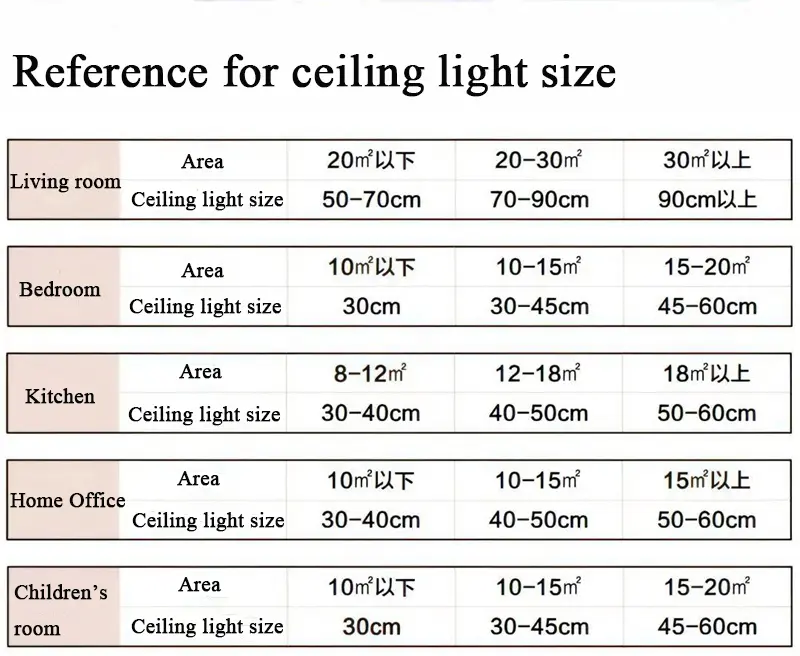
When choosing the ceiling light,size is crucial.The size of light should be appropriately chosen based on the installation space;Neither too large nor too small is suitable.Different sizes are recommended for bedrooms and living room to ensure optimal light coverage.If the size too large ,it may take up too much space in the living room,severely obscuring the overall design and highlighting the lack of the height in the bedroom.On the other hand,if the size too small,corners will be dimly lit.To ensure the right size,you can follow the following method to choose:For bedroom lights,the diameter can be calculated as “( length+width)/12”(in CM);For Living Room Lights,the diameter can be estimated as“(length+width)/10”.If you are not sure about the specific size ,you can refer to the figure below:
2. Ensure true color reproduction
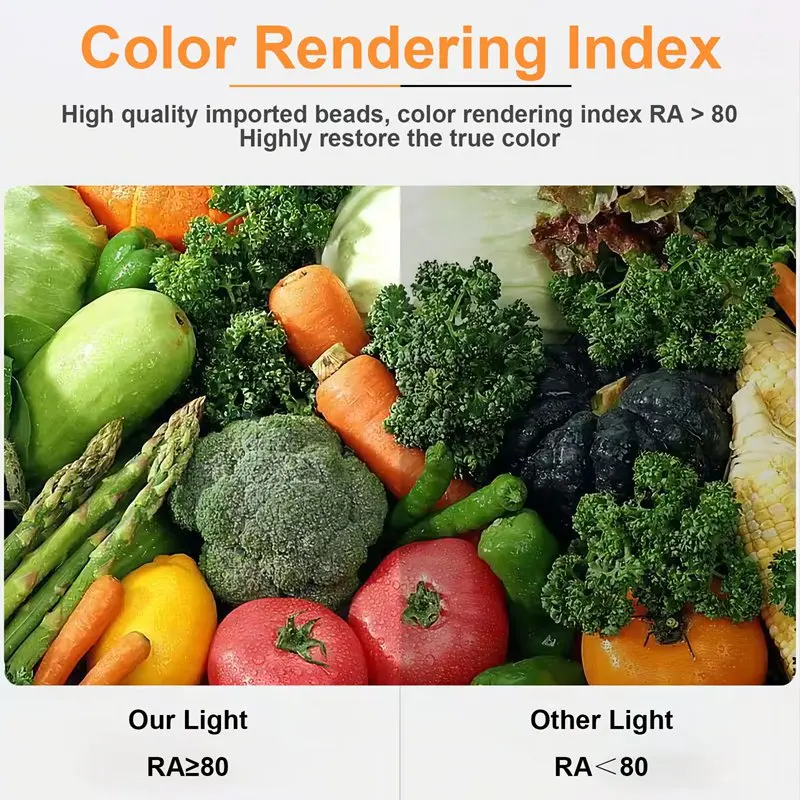
When purchasing Ceiling Lights,many people focus solely on the design,brand and price,but overlook a crucial factor:the color rendering index(CRI).This is crucial because the higher the CRI more accurately reproduces the original color of an object,minimizing color shift,improving visual comfort,reducing visual fatigue and protecting eyesight.Therefore choose a CRI of 80% or higher.Avoid lights with CRI of 80% or lower,as these will result in poor color reproduction,distorted and dimmed colors.Long term exposure to such lights can easily lead to visual fatigue and even impair color discrimination.Therefore CRI is crucial when selecting the light,especially for those with children or elderly care in the home.The CRI of Ceiling Lights provided by Winway is maintained at above 80% ,ensuring high-quality color reproduction,better protecting eyesight and giving you a better lighting experience.
3. Pay attention to flicker
Except for CRI,this is one lighting indicator which often overlooked because it’s generally difficult to detect with the naked eye.
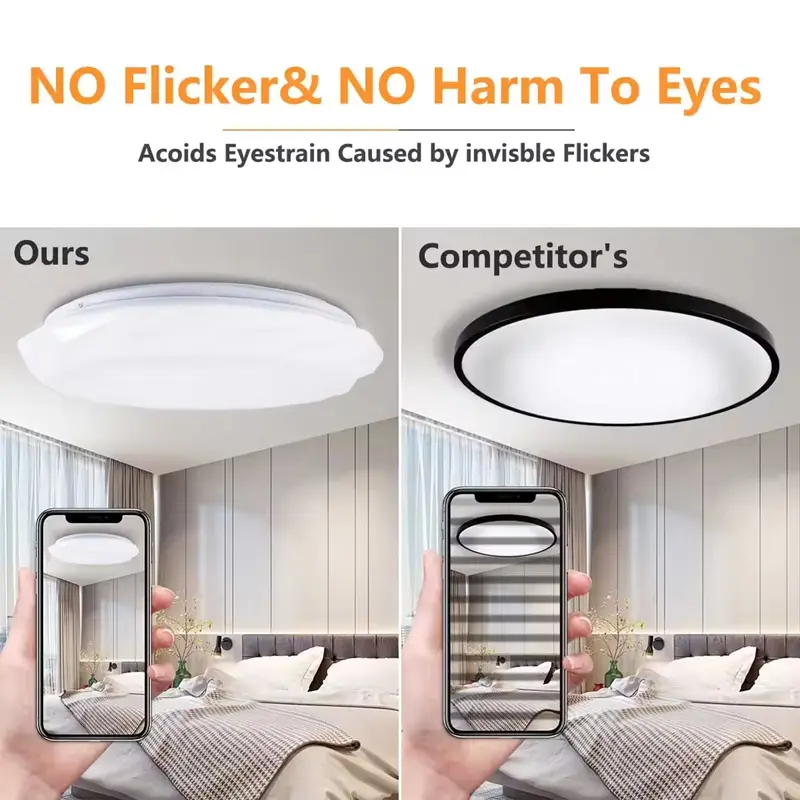
The Ceiling light without visible flicker provides stable light,reduces visual fatigue and protect eyesight,it will suitable for Children’s rooms.Adopt simple and available test generally:Using your phone’s camera to record a video directly at a lit Ceiling light,if without black streaks flicker,there’s no flicker.Ceiling light with flicker exhibit noticeable light fluctuations which can easily cause visual fatigue and impaired vision,will damage eye health use in a long-term.
4. The light not too clod,the wattage not be too low
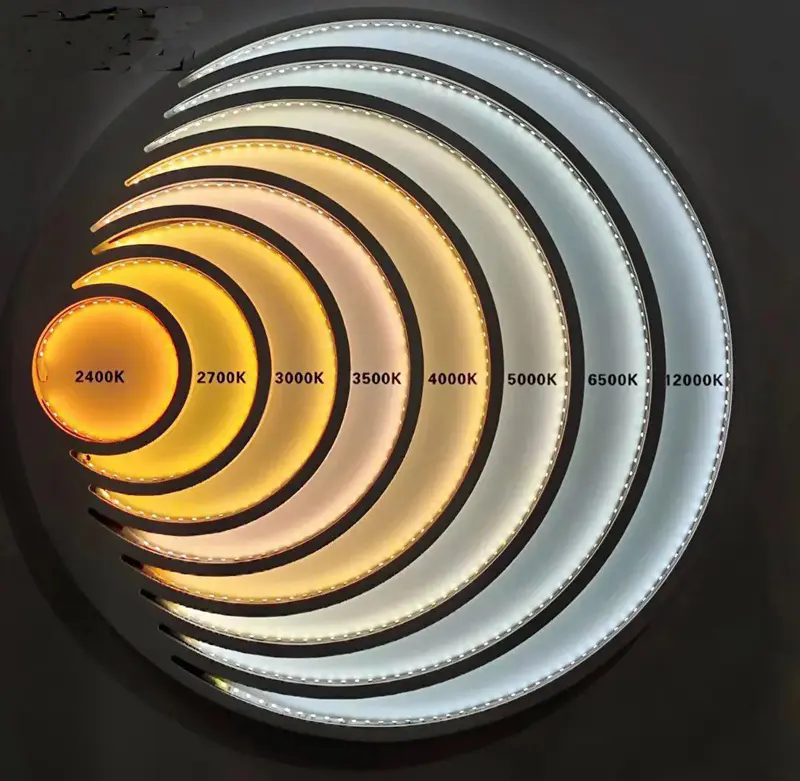
Light has color.Generally speaking,whether in the office or at home,we use main three lighting color:Cold white light,Warm light and Neutral light.All these called color temperatures.Higher color temperatures(above 5000K) create cooler,whiter and brighter light;Lower color temperatures(below 3000K) create warmer,yellower and more inviting light.Normally speak warm and cozy spaces create a sense of comfort so that warm light with the color temperature of 3000K to 3500K is preferred for Home Lighting.However some people dislike the particularly yellowish light so can opt for 4000K warm white light,which closer to daylight and create a more soothing effect;
Kitchen and bathrooms are special spaces in the home,ideally suited to 5000K white light;
Cool white light above 5000K tends to have a bluish cast and not recommended for use in home,except in certain commercial spaces.
Friendly Reminder:The color temperature of lights in the home can be mixed and matched.For example,ceiling lights and downlights in the corridor can use 4000K warm white or 3500K warm light for large-scale lighting.Small ares such as table lamp and linear lights on cabinets can use 3000-3500K warm light for atmosphere lighting.This combination of lighting will make the home feel more cozy.
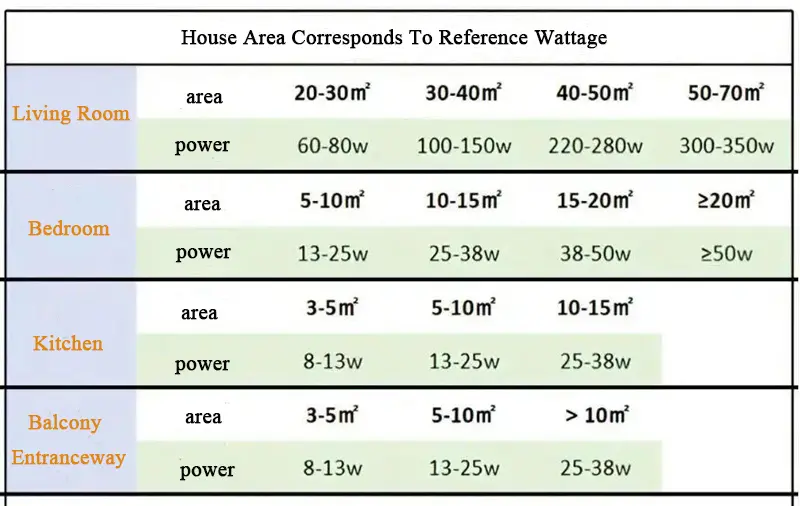
Beside light color,brightness is major factor in choosing a lamp,and this is where the wattage of the lamp comes into play.The higher the wattage,the brighter the light.If don’t know how to choose,can refer to the picture as follow↓
5. Appearance Design
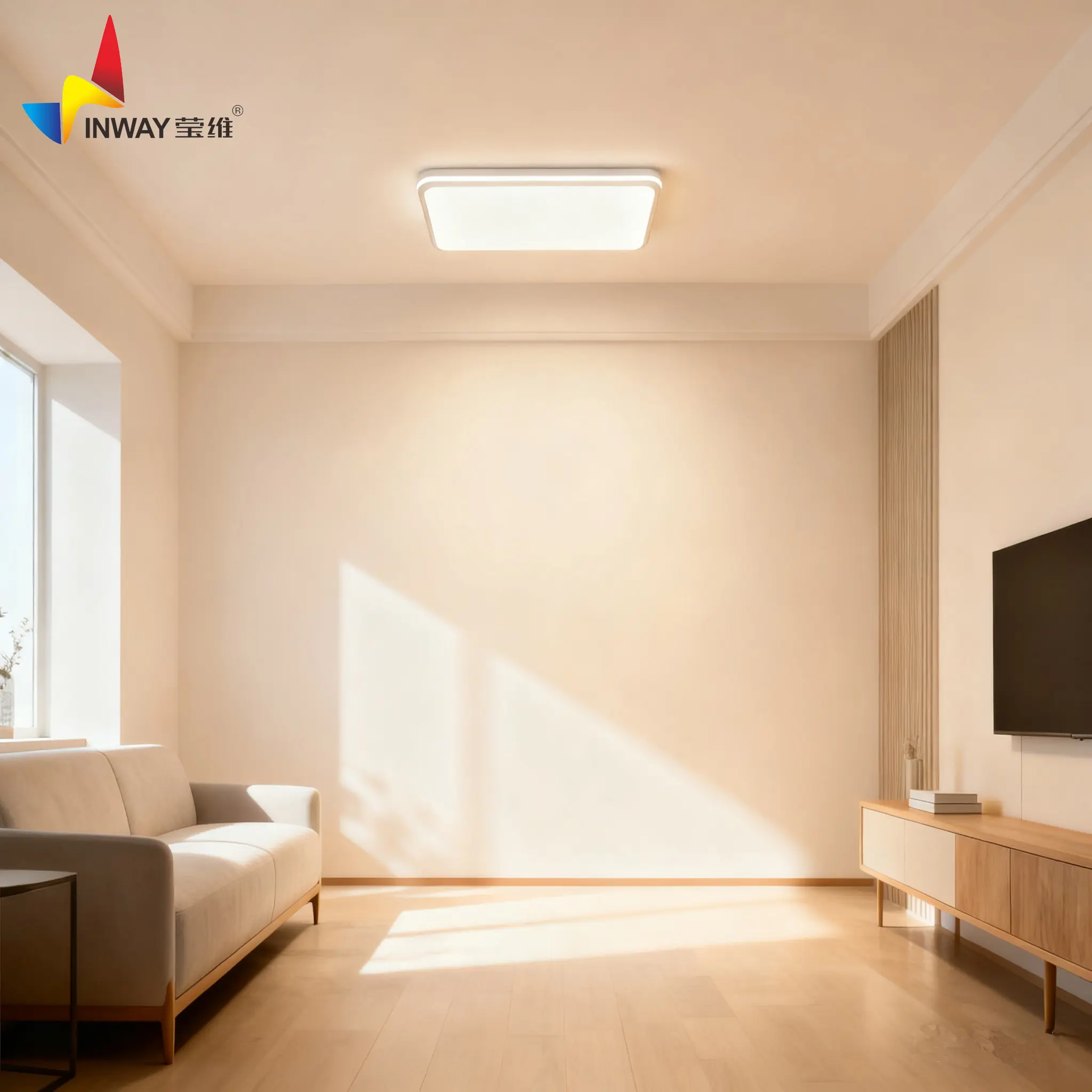
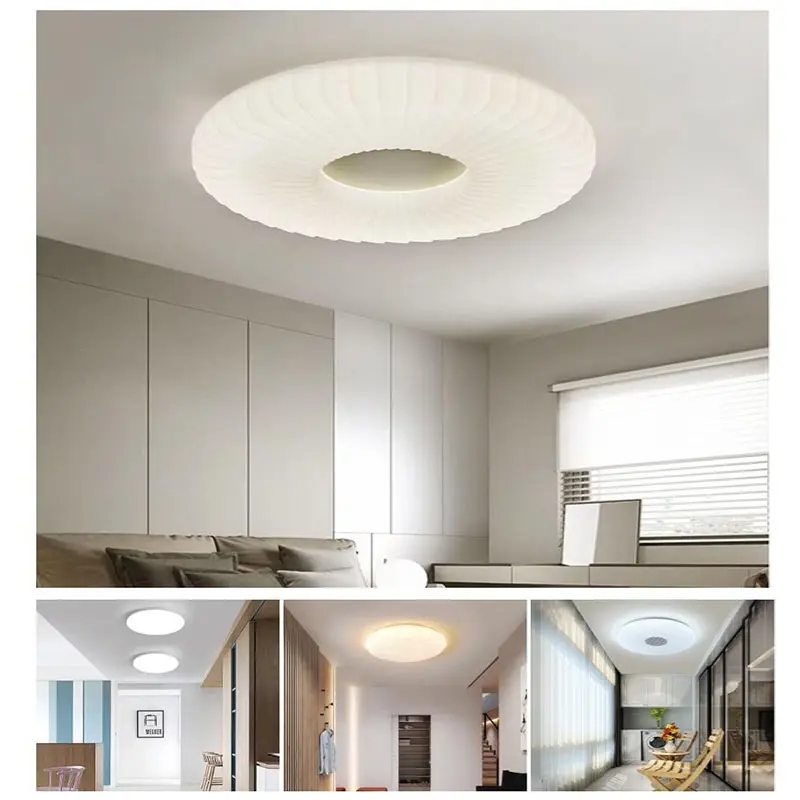
As the primary lighting source in your home,ceiling light provide both illumination and decorative functions,so choosing a style that matches the overall decor is crucial,When choosing different styles of lights,consider the overall decor of your space and make the appropriation choice.The lights should illuminate the space while also adding the beautiful,comfortable and layered feel.
6. Material
There are many materials for ceiling light on the market,each of them has certain advantages and disadvantages.You can choose the appropriate one according to the actual use environment and lighting requirements:
| Name | Advantages | Disadvantages |
| PMM (Acrylic) | --Excellent light transmittance:High visible light transmittance and soft,without glare,low yellowing; --Balanced mechanical properties:High hardness,easy surface polishing,impact resistance and shatter resistance; --Flexible processing:the variety of molding processes are available.Facilitating the creation of complex shapes; --Environmentally friendly:No harmful substances are released at room temperature. | --Poor heat resistance:The heat deformation temperature only 70-90°C and it easily softens and deforms at high temperature; --Poor scratch resistance:Surface hardness is lower than glass.It is easily scratched by daily; --Higher cost:The price is higher than general plastics such as PVC,PP. |
| PVC | --Extremely low cost:Highly cost-effective,suitable for large scale mass production; --Strong chemical resistance:Resistance to corrosion by conventional chemical; --Excellent processability:Can be produced in both soft or hard forms through injection molding,extrusion and calendering; --Best flame retardancy:Contains chlorine,achieving V0 flame retardancy without need for additional flame retardants,ensuring safety. | --Weak weather resistance:Long term exposure to sunlight can cause aging,brittleness and fading; --Susceptible to cracking at low temperatures:Soft PVC become hardens at low temperatures,while hard PVC impact resistance decreases significantly at low temperatures.Making it unsuitable for outdoor use in cold environments. |
| PP | --Extremely chemically resistant:Resistant to nearly all acids,bases and solvents except strong oxidizing acids,it is one preferred material for chemical corrosion protection; --Excellent heat resistance:With the heat deformation temperature of 100-120°C,it can be used for extended periods below 100°C; --Low density:With density only 0.90-0.91g/cm³,can reduces product weight; --Environmentally friendly and nontoxic:No releases harmful substances at room temperature,meets FDA standards and highly recyclable. | --Poor low-temperature impact resistance:It is prone to brittle cracking below 0°C and requires the addition of toughening agent; --Poor weather resistance:Susceptible to UV rays,can age and discolor after long term outdoor use,requiring the addition of UV inhibitor; --High shrinkage:Can easily lead to dimensional deviations in the product,requiring precise control of mold and processing parameters. |
| PC | --Top-notch impact resistance:Its impact strength is 5-10 times that of ordinary plastic,allowing it to withstand severe impacts without shattering at room temperature; --Excellent heat resistance:It can be used for extended periods below 120°C and remains tough down to -40°C; --Excellent light transmittance:Its visible light transmittance is 88%-90%(close to PMMA),and it is UV resistant and resists yellowing; --Best flame retardancy:It achieves V2 flame retardancy without the addition of flame retardants |
-- High cost: 3-5 times the price of PP and PVC, and only lower than PMMA; -- Poor chemical resistance: Easily corroded by organic solvents and prone to surface cracking; -- Difficult to process: High melt viscosity requires high-temperature and high-pressure processing, demanding equipment requirements, and post-molding annealing to eliminate internal stresses. |
| PS | --High transparency: General-purpose PS (GPPS) with light transmittance of 80%-85% and excellent surface gloss. --Excellent processability: Its excellent melt flowability allows for rapid injection molding of complex, thin-walled parts, while maintaining dimensional stability after molding; --Low cost: Its price is only slightly higher than PVC, making it suitable for large-scale, low-cost production; --Excellent insulation: With exhibits excellent high-frequency insulation performance. | -- Poor impact resistance: Very brittle, easily cracking or shattering with even the slightest impact. -- Poor heat resistance: The heat deformation temperature only 60-80°C, it cannot withstand hot water or high temperatures and easily softens. -- Poor weather resistance: Susceptible to aging, brittleness, and fading with long-term exposure. |
| ABS | --Balanced properties: Chemical resistance, high hardness, high toughness, impact resistance, high gloss, and easy processing make it the "best-performing general-purpose plastic overall." --Excellent impact resistance: At room temperature, its impact strength surpasses for PS and PP.While maintaining certain degree of toughness (better than PC) at low temperatures (-20°C). --Excellent surface quality:High surface gloss makes it easy to dye and electroplate, resulting in a refined appearance. --Excellent processability: The melt flowability surpasses for PC.Allowing for injection molding of complex structural parts with high dimensional stability. |
-- Lower heat resistance: Heat deformation temperature is 80-110°C, lower than PC and PP, making it unsuitable for use in high-temperature environments. -- Poor weather resistance: Susceptible to UV degradation. -- Weak chemical resistance: Not resistant to strong solvents and easily corroded and dissolved. |
Winway Tip: Choosing the right ceiling light can create unexpected effects. However, the single ceiling lights can appear fragmented and lack depth.Therefore you can supplement it with wall lamps, floor lamps, light strips, table lamps, track lights, downlights and spotlights, and other lighting fixtures. When light requirements are less critical, you can turn off the ceiling light and use supplementary lighting to create a strong atmosphere. If you need further assistance, please feel free to contact Winway Lighting. We will provide professional consulting services and help you select the right, high-quality lighting.