10 Best LED Light Fixtures for Global Buyers
Choosing the right Led Light Fixture can shape energy costs, comfort, safety, and long-term maintenance. For global buyers, the decision involves more than brightness or attractive design. Voltage compatibility, beam angle, color temperature, ingress protection, and expected lifespan deserve careful attention.
This guide reviews ten practical LED light fixtures for offices, warehouses, retail spaces, homes, and outdoor areas. Each option is considered through real purchasing concerns, including lumen output, CRI performance, heat management, installation method, warranty coverage, and supplier communication. A fixture that works well in a dry European office may perform poorly in a humid coastal warehouse. Small details matter.
Specifications can also be misunderstood. A high wattage does not always mean better illumination. Likewise, a long warranty may hide difficult replacement conditions. Buyers should verify regional certifications, plug standards, dimming compatibility, packaging quality, and after-sales support before placing large orders. We have emphasized measurable features, but product performance still depends on installation and usage. That limitation deserves honest attention.
Some choices are not perfect.
The best fixture depends on the project, budget, climate, and maintenance plan. By comparing these ten selections carefully, international purchasers can reduce avoidable risks and choose lighting that delivers dependable value. A reliable supplier should provide test reports, clear technical drawings, accurate samples, and responsive answers. Those basics often reveal more than polished product photographs.
LED Light Fixture Basics for International Buyers
10 Best LED Light Fixtures for Global Buyers
LED light fixtures vary widely, even when their shapes look identical. International buyers should check voltage, frequency, lumen output, color temperature, and beam angle. A fixture designed for 120 volts may not operate safely on a 230-volt grid. Confirm the input range on the datasheet, not only on the product page. Also inspect the driver, because poor drivers can cause flickering, heat, or early failure. For warehouses and outdoor areas, review the IP rating and operating temperature. A bright fixture is not automatically an efficient fixture.
Tips: Request a sample before placing a large order. Test it with your local power supply for several days. Ask for photometric files, efficiency data, installation instructions, and independent test reports. Check whether the stated warranty covers the driver and light source separately. Packaging also deserves attention. Thin corner protection can lead to cracked diffusers after long-distance shipping. Confirm carton dimensions and replacement-part availability before payment.
One sourcing mistake is trusting identical wattage as proof of identical performance. It is not. Compare delivered lumens, thermal design, color consistency, and measured lifetime. Certifications should match your destination market and product category. Ask the supplier to explain each report in plain language. If answers remain vague, pause the purchase. I have found that a slightly higher initial cost can reduce maintenance visits, rejected shipments, and disappointing field results. Still, specifications can be imperfect, so verify critical claims with physical testing.
Key Criteria for Comparing LED Light Fixtures
10 Best LED Light Fixtures for Global Buyers
Key Criteria for Comparing LED Light Fixtures
Comparing LED light fixtures starts with measurable performance, not appearance. Check lumen output, wattage, and efficacy together. A bright fixture may still waste energy. For offices, I examine the delivered light after the diffuser, not only the chip rating. Color temperature also matters. Warm light suits hospitality areas, while neutral white often supports retail and workspaces. Choose a color rendering index that matches the application. High CRI can improve product displays and visual comfort.
Beam angle affects spacing and glare. A narrow beam can create bright spots on a warehouse floor. A wide beam may leave shelves underlit. Review the driver, dimming method, input voltage, and flicker data. These details become important when buyers install fixtures across different electrical systems. Check ingress protection for damp or dusty locations. Thermal design deserves attention too. Heat trapped inside a ceiling can shorten LED life.
I have seen attractive datasheets hide unclear testing conditions. Ask for photometric files, safety documents, warranty terms, and replacement plans. Ask for proof. Test samples yourself. Measure light levels at the actual mounting height. Compare several units after continuous operation, because heat can change brightness and color. I once underestimated installation labor, and the final project cost increased. That mistake still influences my comparisons. The best choice is not always the fixture with the highest lumen rating. It should fit the site, maintenance skills, local voltage, and documented performance.
10 Best LED Light Fixtures for Global Buyers - Key Criteria for Comparing LED Light Fixtures
| Rank |
Generic Fixture Type |
Best Use |
Rated Power |
Light Output |
Typical Efficacy |
Color Temperature |
Color Rendering |
Beam / Distribution |
Input Voltage |
Ingress Protection |
Rated Life |
Controls & Dimming |
Mounting |
| 1 |
Commercial Recessed Downlight |
Retail stores, offices, hospitality interiors |
9 W |
800 lm |
89 lm/W |
3000 K / 4000 K / 5000 K |
CRI 90 |
90° wide beam |
120 V AC |
IP44 |
25,000 hours |
Phase-cut dimming |
Recessed ceiling |
| 2 |
Edge-Lit LED Panel |
Grid ceilings in offices, schools and healthcare areas |
40 W |
4,000 lm |
100 lm/W |
4000 K / 5000 K |
CRI 80+ |
120° diffuse |
120–277 V AC |
IP40 |
50,000 hours |
0–10 V dimming; occupancy sensor compatible |
T-grid recessed or surface-mounted |
| 3 |
LED Troffer |
Large commercial offices and institutional buildings |
40 W |
5,000 lm |
125 lm/W |
3500 K / 4000 K / 5000 K |
CRI 80+ |
85° batwing distribution |
120–277 V AC |
IP40 |
50,000 hours |
0–10 V dimming; daylight-control compatible |
Recessed 2 × 4 ft ceiling grid |
| 4 |
LED Strip Light |
Industrial aisles, workshops, corridors and utility areas |
32 W |
4,000 lm |
125 lm/W |
4000 K / 5000 K |
CRI 80+ |
120° linear distribution |
120–277 V AC |
IP20 |
50,000 hours |
0–10 V dimming; emergency option available |
Surface, suspended or continuous-row |
| 5 |
LED High-Bay Fixture |
Warehouses, factories and high-ceiling facilities |
150 W |
22,500 lm |
150 lm/W |
4000 K / 5000 K |
CRI 80+ |
60° / 90° / 120° options |
120–277 V AC |
IP65 |
50,000 hours |
0–10 V dimming; motion sensor compatible |
Chain, cable or hook suspended |
| 6 |
Vapor-Tight Linear Fixture |
Parking garages, food-processing areas and damp locations |
40 W |
5,200 lm |
130 lm/W |
4000 K / 5000 K |
CRI 80+ |
120° diffuse |
120–277 V AC |
IP65 |
50,000 hours |
Optional 0–10 V dimming |
Surface-mounted |
| 7 |
LED Wall-Pack Light |
Building entrances, exterior walls and security lighting |
40 W |
5,200 lm |
130 lm/W |
3000 K / 4000 K / 5000 K |
CRI 70+ |
Type III forward throw |
120–277 V AC |
IP65 |
50,000 hours |
Photocell and 0–10 V dimming options |
Wall-mounted junction box |
| 8 |
LED Canopy Fixture |
Fuel stations, covered walkways and parking structures |
100 W |
13,000 lm |
130 lm/W |
4000 K / 5000 K |
CRI 70+ |
120° wide distribution |
120–277 V AC |
IP65 |
50,000 hours |
0–10 V dimming; occupancy sensor compatible |
Surface-mounted ceiling |
| 9 |
Outdoor LED Floodlight |
Sports grounds, façades, yards and security perimeters |
100 W |
14,000 lm |
140 lm/W |
3000 K / 4000 K / 5000 K |
CRI 70+ |
30° / 60° / 90° options |
120–277 V AC |
IP66 |
50,000 hours |
0–10 V dimming; photocell compatible |
Adjustable yoke or slip-fitter |
| 10 |
LED Bollard Fixture |
Pedestrian paths, campuses, parks and residential developments |
30 W |
3,600 lm |
120 lm/W |
3000 K / 4000 K |
CRI 80+ |
Type V symmetric distribution |
120–277 V AC |
IP65 |
50,000 hours |
Photocell and wireless-control options |
Anchor-bolt surface base |
Comparison note: Values shown are representative specifications for commercially available LED fixture categories. Actual performance may vary by housing size, optic, driver, ambient temperature and regional electrical configuration. Rated life is typically based on an L70 maintenance-life rating.
Ten Leading LED Fixture Types for Global Applications
10 Best LED Light Fixtures for Global Buyers
Ten Leading LED Fixture Types for Global Applications
Global buyers need more than high lumen output. They need reliable optics, suitable voltage, thermal control, and recognized safety testing. The U.S. Department of Energy reports that LED products use at least 75% less energy than incandescent lighting and can last up to 25 times longer. That advantage depends on correct specification.
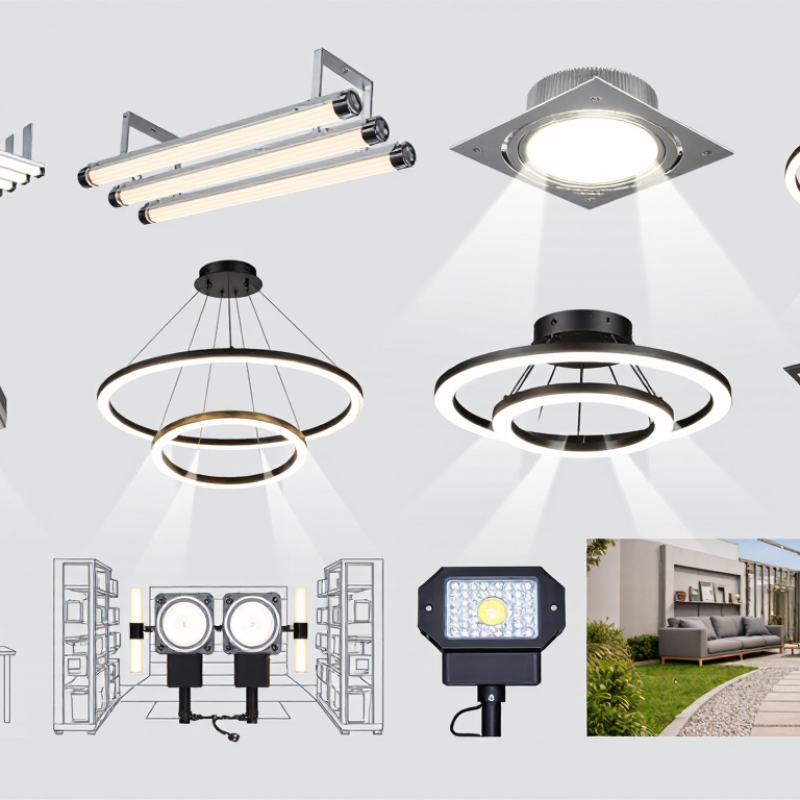
The ten leading fixture types serve different environments. LED panels suit offices, schools, and hospitals with low-glare ceilings. Downlights provide focused illumination in retail and residential interiors. Tubes and battens support warehouses and utility spaces. High-bay fixtures handle tall industrial ceilings, while low-bay models serve workshops and smaller halls. Streetlights improve road visibility with controlled beam patterns. Floodlights cover yards, façades, and sports areas. Linear fixtures create continuous light above counters or production lines. Track lights offer adjustable retail displays. Wall packs strengthen security lighting around entrances and loading zones.
The International Energy Agency identifies lighting as a major electricity-use area, making efficiency upgrades globally important. However, wattage alone is a weak buying guide. Check delivered lumens, glare ratings, color consistency, surge protection, and ambient temperature limits. In site audits, poor heat dissipation often explains early lumen depreciation. A fixture can look efficient on paper. Field performance may differ. I would also question overly optimistic lifetime claims without maintenance data, test standards, and warranty conditions. Local grid stability matters too, especially in regions with voltage fluctuations.
Regional Standards, Safety Rules, and Installation Needs
10 Best LED Light Fixtures for Global Buyers
Global buyers should compare more than brightness, wattage, and appearance. Regional standards can change the safest choice. Many markets use 100–127 volts, while others use 220–240 volts. Frequency may also be 50 or 60 hertz. Confirm the fixture and driver match the destination supply before ordering.
Check safety documentation against local requirements, including accepted electrical testing and grounding rules. Certification marks alone may not prove approval in every country. Ask for test reports, installation instructions, and maintenance details. A reliable supplier should explain these documents clearly. Vague answers deserve caution.
Installation conditions matter just as much. A bathroom ceiling may require moisture protection, while a warehouse may need impact resistance. An IP44 fixture is not suitable for every wet location. Confirm the IP rating, fire-clearance rules, ceiling-box size, and earth connection. Dimmable models also need compatible switches and drivers. I have seen projects fail because the lamp fit physically but not electrically. That mistake is expensive. Local codes should guide the final selection, and a qualified electrician should inspect permanent wiring. Even experienced buyers can overlook regional inspection practices, especially when product descriptions appear complete.
How to Select the Best LED Fixture for Each Project
Selecting the best LED light fixture starts with the project, not the product catalogue. Define the space, mounting height, operating hours, and visual task before comparing models.
A warehouse aisle needs controlled beams and high output, while a hotel corridor needs comfortable brightness and low glare. Measure the target area carefully. Guesswork often creates dark corners or wasted energy.
Check the technical details closely. Compare delivered lumens, beam angle, colour temperature, colour rendering, and power factor.
For outdoor projects, review IP and impact ratings, operating temperature, surge protection, and corrosion resistance. Confirm voltage compatibility before ordering across borders. Local electrical codes and required certifications also matter. A lower price can become expensive when replacement parts are difficult to source.
Controls deserve equal attention. Dimming, occupancy sensors, emergency functions, and network compatibility can change the fixture choice. Ask for photometric files and a sample installation when the project is sensitive.
A drawing may look perfect on paper. It can feel harsh at eye level. During site reviews, I have seen small mounting changes improve comfort more than higher lumen output. That lesson is easy to overlook.
Check warranty terms, driver access, maintenance time, and spare-part availability. The best fixture is not always the brightest; it is the one that performs reliably in the actual space.



 Email
Email Whatsapp
 WeChat